
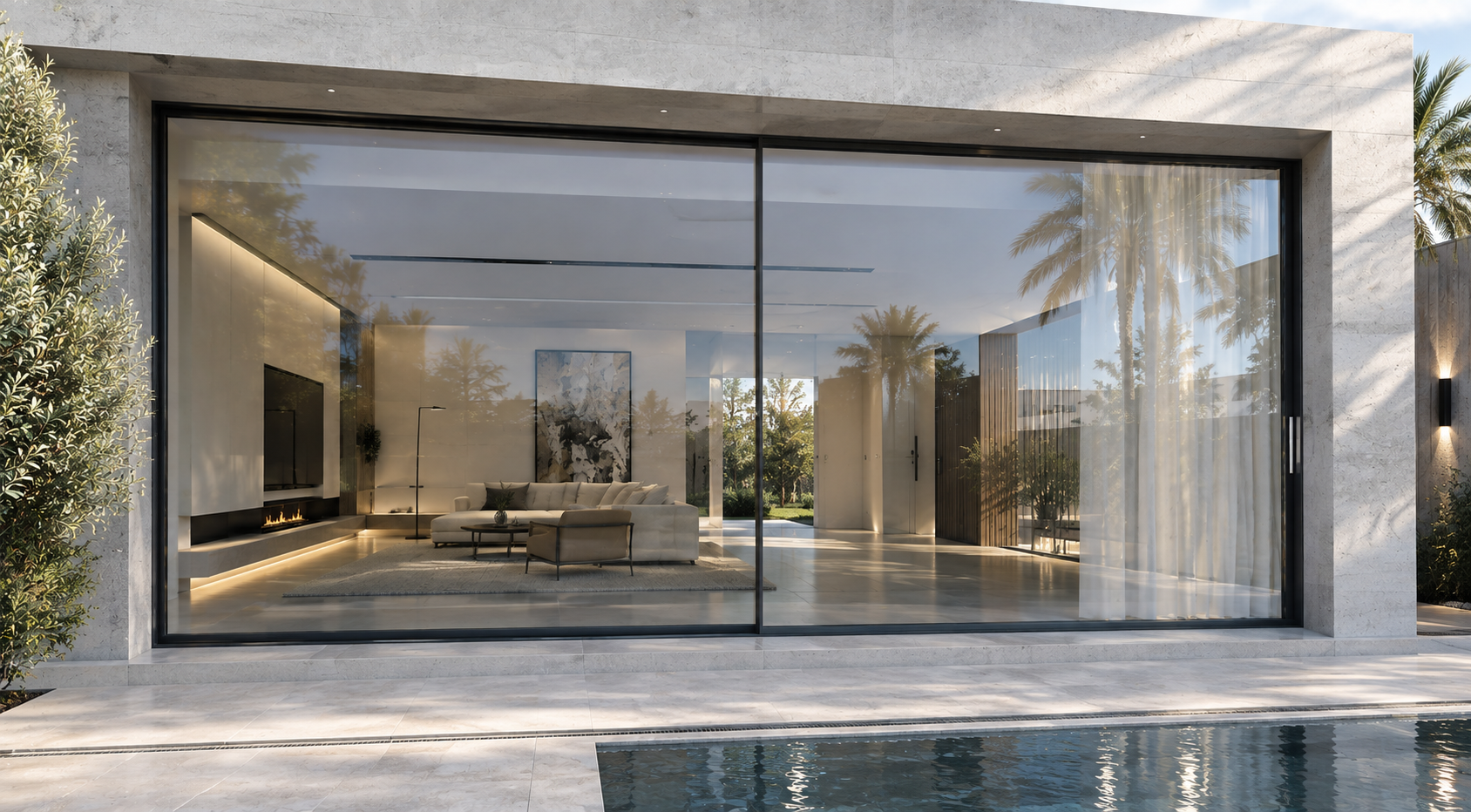
The best balcony sliding door for a Dubai apartment is one chosen for the building it goes into, not just the look. On higher floors that means a system rated for wind pressure, tight dust and water seals, and glass that cuts traffic and construction noise. Before you order anything, check what your building management or owners' association allows, because replacement doors in apartments usually need their sign-off.
This guide explains what matters when you replace or upgrade a balcony door in a Dubai apartment: approvals, wind, noise, dust, glass and the questions to put to any supplier. For the full range of systems we make, see our aluminium sliding doors in Dubai.
Why apartment balconies are different from villa doors
A villa owner can usually choose almost any door style, size and colour. An apartment owner works within limits set by the building: a shared facade, a fixed opening in the structure, and rules that keep the tower looking uniform. The door is also more exposed. Wind pressure rises with height, fine sand reaches every floor, and many apartments sit next to busy roads, metro lines or ongoing construction.
That changes the order of priorities. On a ground-floor villa terrace, sightlines and opening width often come first. On the 20th floor of a tower, sealing, strength and noise control usually matter more.
Step one: check building approvals before you choose a door
In most Dubai towers the balcony door forms part of the building envelope, so changes to it are rarely a private matter. Before you request quotes, it is worth asking your building management or owners' association:
- Whether replacing the balcony door needs a written approval or no-objection letter, and who issues it.
- Whether the frame colour, glass tint and door style must match the existing facade.
- What documents they need from the contractor, such as drawings, product details, insurance or a method statement.
- When work is allowed, how materials reach the unit, and whether the service lift must be booked.
- If you are a tenant, whether the landlord's written consent is also required.
Rules vary from building to building, so treat the building's own requirements as the final word. A good supplier will help you prepare the technical information the building asks for.
Wind on high floors: what to ask about
Wind load is the main technical difference between a low-rise door and a high-rise one. On upper floors, gusts push on large glass panels, test the locking points and force air and water against the seals. A door that is fine at ground level can rattle, whistle or leak higher up.
When you compare systems, ask your supplier:
- Whether the profile and glass have been selected for the wind exposure at your floor height.
- How the interlock (where the two panels meet) is reinforced and sealed.
- How many locking points the sash has and how the door is held closed in strong wind.
- Whether the track design drains water away from the interior during wind-driven rain.
Maximum panel sizes and glass thicknesses depend on the system and the exposure, so we confirm these on your quotation rather than quoting a general figure.
Noise: choosing glass for a quieter apartment
Traffic on Sheikh Zayed Road, aircraft, metro lines and construction noise are common complaints in Dubai apartments. The frame helps by sealing tightly, but the glass does most of the work.
Double glazing
Double-glazed glass units trap a sealed cavity between two panes. This reduces heat coming in from a sunny balcony and also softens outside noise. If heat is your main concern, our guide to double glazing for UAE heat explains solar control and low-E coatings in more detail.
Laminated and acoustic glass
Laminated glass bonds two panes with an interlayer that holds the glass together if it breaks, which suits balconies where safety matters. Using panes of different thickness, or a laminated pane within a double-glazed unit, generally improves noise reduction further. Ask your supplier whether an acoustic interlayer is available for the system you are considering, and request the glass manufacturer's data sheet so you can compare like with like.
Dust and sand: seals, tracks and drainage
Fine dust finds its way through any gap, and on a balcony it collects in the bottom track where it wears rollers and makes the door heavy to slide. Points to look for:
- Brush and rubber seals around the sash and interlock, fitted continuously rather than in short pieces.
- A track profile that is easy to clean, without deep channels that trap sand.
- Proper drainage so water from rain or balcony cleaning exits outside instead of pooling.
- Quality rollers sized for the panel weight, so the door keeps sliding smoothly as dust builds up between cleans.
A short vacuum of the track every week or two during dusty months does more for a sliding door's lifespan than anything else an owner can do.
Comparing balcony sliding door options
The right system depends on your building's rules, floor height and budget. This table summarises the general trade-offs; exact figures are confirmed on your quotation.
| Option | Best suited to | Strengths | Points to check |
|---|---|---|---|
| Standard aluminium sliding door | Most apartment replacements | Robust, familiar look that often matches the existing facade | Seal quality, interlock strength, roller rating |
| Thermal break aluminium sliding door | Sun-facing balconies and high-floor units | Insulated frame reduces heat passing through the aluminium | Whether the building allows a different profile depth |
| Slim-frame sliding door | Units where the view is the priority | Narrow sightlines and more visible glass | Wind exposure at your floor, panel weight, building approval for a changed look |
| Lift-and-slide door | Large, heavy panels | Panel lifts off its seals to move, then drops down to seal when closed | Availability for your opening size, ask your supplier whether this is offered |
Frames can be specified with a thermal break aluminium profile where heat gain is a concern. If you are drawn to a narrow frame, our article on slim, ultra-slim and ghost doors compares minimal systems, and you can see the range on our slim sliding doors page.
Replacing an old balcony door: what the job involves
Replacement in an occupied apartment needs more planning than a new build. A typical sequence is:
- Site survey to measure the opening, check the existing frame fixings and note the floor level and exposure.
- Approval pack with drawings and product details submitted to building management.
- Fabrication of the frame and glass to the measured size.
- Removal and installation, including making good the opening, sealing the perimeter and protecting floors and furniture.
- Handover, with a check of locking, sliding action, seals and drainage.
Ask your supplier how long the opening will be left without a door, how the old door is removed from the building and how the site is kept clean. Timescales depend on the system and the building's access rules, so we confirm them on your quotation.
Sliding door or something else?
Sliding doors suit most balconies because the panels stay within the frame and do not swing into furniture or the balcony space. If you are weighing alternatives for a larger terrace, our comparison of bifold vs sliding doors in Dubai sets out where each works best.
Frequently asked questions
Do I need permission to replace my balcony door in a Dubai apartment?
In most buildings, yes. The balcony door is usually part of the shared facade, so building management or the owners' association typically needs to approve it. Tenants should also get the landlord's consent. Check with your building before ordering.
Can a new sliding door reduce noise from the road?
A well-sealed frame with double glazing or laminated glass usually makes a noticeable difference compared with an older single-glazed door. The improvement depends on the glass build-up, the seals and how the door is installed, so ask for the glass data sheet when comparing quotes.
How do I stop sand getting in around my balcony door?
Choose a system with continuous brush and rubber seals and good drainage, and keep the bottom track clean. If an existing door lets in a lot of dust, worn seals or rollers are often the cause.
Are slim-frame sliding doors suitable for high floors?
They can be, but panel size, glass thickness and wind exposure need to be checked for your specific floor and opening. Your supplier should confirm the system is suitable before you commit.
Can I change the colour of my balcony door frame?
That depends on your building. Many towers require frames to match the existing facade from the outside. Ask building management before choosing a colour.
Get advice for your balcony door
If you are planning to replace or upgrade a balcony door, our team can survey the opening, recommend a suitable system and glass, and help you put together the information your building management needs. Call or WhatsApp +971 52 953 5300, email info@fourseason.ae, or visit our factory in Al Quoz, Dubai. You can also explore our sliding door systems or request a free quote and site visit.