
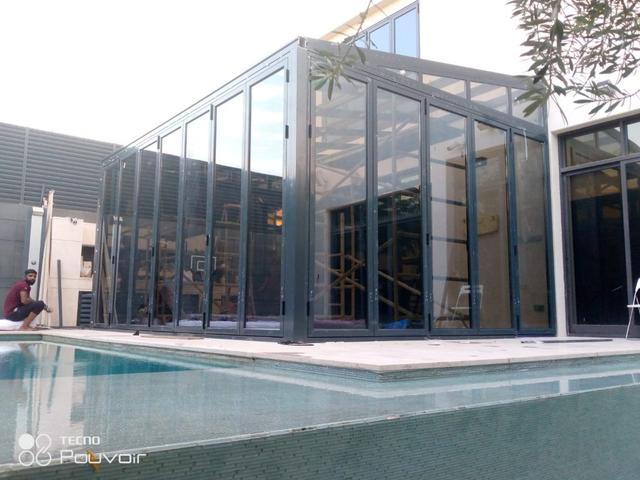
A glass room in Dubai can be the best room in the house or the one nobody uses from May to October. The difference is rarely the glass room itself. It is whether the glass, roof, frames, shading and cooling were specified for UAE heat from the start. This guide explains where the heat comes from and how to design it out. For our glass room service, see glass rooms in Dubai.
Why glass rooms overheat
Sunlight passes through glass and warms every surface it hits. That heat is re-emitted as longer-wave radiation that clear glass does not let back out easily, so heat builds up: the greenhouse effect. On top of that, heat conducts in through ordinary aluminium frames and radiates down from a hot roof. In the UAE, where summer sun is intense and high in the sky, the roof is usually the biggest source of heat.
1. Start with the roof
An insulated solid roof keeps a glass room far cooler than an all-glass roof because the high summer sun hits the roof for most of the day. If you want overhead daylight, use a solid insulated roof with a glazed section or skylight, rather than glazing the whole roof. If you do choose a glass roof, it needs solar-control glass and external shading.
2. Choose glass by its solar performance, not just its thickness
Ask your supplier for two numbers for every glass option:
- Solar factor (g-value or SHGC): the share of solar heat that passes through. Lower means less heat.
- Light transmission: how much daylight passes through. Higher means a brighter room.
Solar-control and low-E coatings on double-glazed units lower heat gain while keeping good daylight, which single clear glass cannot do. For overhead glass, use a laminated inner pane so the glass stays in place if it breaks.
3. Use thermal-break frames
Aluminium conducts heat well. Thermal-break profiles separate the outer and inner parts of the frame with an insulating strip, so the hot outer face does not warm the inside. With large glass areas and many frames, especially with bifold doors, this makes a noticeable difference.
4. Shade outside, not inside
Internal blinds stop glare, but the heat has already passed through the glass and stays in the room. External shading stops the sun before it reaches the glass. An aluminium pergola, louvres or roof overhangs on the most exposed sides are the most effective. In the UAE, west-facing glass takes the harshest afternoon sun.
5. Plan the air conditioning early
A glass room needs more cooling capacity per square metre than a solid room. Ask your HVAC contractor to size the AC using the actual glass area, glass specification and orientation, not floor area alone. Decide early where units, drains and power will go so they can be built in neatly rather than added later.
6. Ventilate in the cooler months
From roughly November to March, many evenings are pleasant enough to open up. Opening panels such as bifold or slim sliding doors, plus high-level vents, let hot air escape and turn the glass room into an indoor-outdoor space.
7. Seal against dust and humidity
Good gaskets, brush seals and proper drainage keep dust out and stop condensation and leaks. Choose door tracks that are easy to clean, because sand in a track makes doors hard to operate and wears the rollers.
Quick checklist before you sign
- Roof type: insulated, glazed section or full glass with shading?
- Glass: double-glazed with solar-control or low-E coating; g-value and light transmission stated
- Frames: thermal-break profiles
- Shading on west and south faces
- AC sized by an HVAC contractor for the glass area
- Opening panels and vents for winter use
- Seals, drainage and cleanable tracks
- Community approval requirements checked
Planning a project? Send us photos and rough dimensions and our team will advise on the right system for your space.
FAQs
Can a glass room be comfortable in a Dubai summer?
Yes, when it combines an insulated or shaded roof, solar-control double glazing, thermal-break frames, external shading and properly sized AC.
Are internal blinds enough?
They reduce glare but not much heat, because the heat has already entered through the glass. External shading is far more effective.
Is tinted glass the same as solar-control glass?
Not necessarily. Tints mainly darken the glass; solar-control coatings are designed to reject heat while keeping more daylight. Compare the g-value and light transmission of each option.